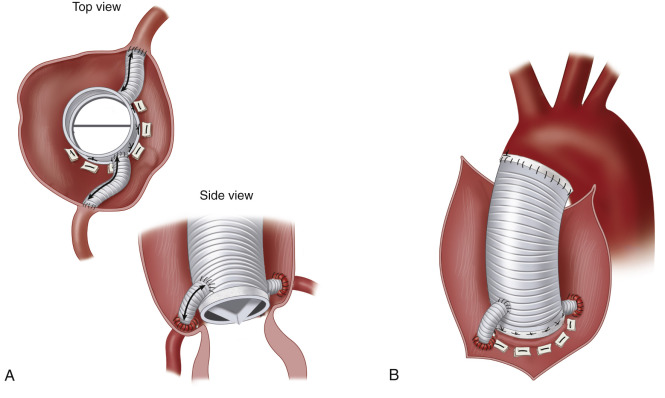
Bentall’s Procedure
Bentall’s Procedure is a major open-heart surgery performed to treat serious diseases of the aortic root and the aortic valve. These conditions may be caused by an aneurysm (ballooning of aorta), dissection (partial tear of aorta), or severe valve disease.
In this procedure, the surgeon replaces:
- The aortic valve
- The aortic root
- The ascending aorta
—all together—using a special tube-like graft that already contains a valve (called a composite graft).
The coronary arteries, which supply blood to the heart muscle, are then carefully reattached to this new graft.
This operation restores normal blood flow, prevents life-threatening complications, and is one of the most effective and durable treatments for complex aortic diseases.
Why Is Bentall’s Procedure Done?
- Aortic Root Aneurysm
A dangerous enlargement or ballooning of the aortic root.
- Aortic Dissection
A tear in the inner layer of the aorta.
- Severe Aortic Valve DiseaseEither narrowing (aortic stenosis) or leakage (aortic regurgitation).
- Connective Tissue DisordersConditions such as Marfan Syndrome or Ehlers-Danlos Syndrome, which weaken the aortic wall.
- Bicuspid Aortic Valve with Root Dilatation
A congenital condition where both the valve and aorta gradually weaken. If not treated in time, these conditions may lead to:- Heart failure
- Aortic rupture
- Sudden cardiac death Bentall’s surgery prevents these complications.
How Is Bentall’s Procedure Performed?
The surgery is done under general anesthesia and typically takes 4–6 hours.
Step 1 — Anesthesia & Heart-Lung Machine
You are put to sleep, and the heart-lung machine temporarily takes over blood circulation.
Step 2 — Exposing the Aorta
The surgeon opens the chest to access the aortic root and aortic valve.
Step 3 — Removing the Diseased Section
The damaged aortic valve, aortic root, and ascending aorta are carefully removed.
Step 4 — Implanting the Composite Graft
A graft tube with an attached mechanical or biological valve is placed and stitched into position.
Step 5 — Reattaching Coronary Arteries
The coronary arteries are reimplanted into the graft so that the heart continues to receive blood.
Step 6 — Restoring Circulation & Closure
Once the repair is complete, normal blood flow is restored, and the chest is closed.
What are the types of Grafts Used?
Mechanical Valve Composite Graft
It has metallic valves attached to it.
Lasts lifelong
Requires lifelong blood-thinning medication
Biological (Tissue) Valve Composite Graft
It is made from animal tissue
Does not require lifelong blood thinners
May need replacement in 10–15 years
Your surgeon will choose the best graft depending on age, lifestyle, medical condition, and future pregnancy plans.
What are the Benefits of Bentall’s Procedure
It treats both the aorta and aortic valve in a single operation
It prevents aortic rupture or dissection
It restores normal heart function and blood flow
It has excellent long-term results
It improves life expectancy and quality of life in patients with serious aortic disease
How does Recovery take place After Bentall’s Procedure?
- ICU Stay (1–2 days) Continuous monitoring of heart function, blood pressure, and healing.
- Hospital Stay (7–10 days) Gradual mobilization, medication adjustment, breathing exercises.
- Full Recovery (6–8 weeks) Depends on age, overall health, and surgical complexity.
- Blood-thinning medicines (if mechanical valve)
- Regular echocardiograms to check graft and valve function
- Lifestyle changes such as a heart-healthy diet and mild exercise
- Cardiac rehabilitation for strength and stamina
- Avoiding heavy lifting for several weeks
What are the Possible Risks and Complications of Bentall Procedure?
Bentall’s Procedure is complex, but very safe in experienced hands.
Possible risks include:
Bleeding or infection
Irregular heart rhythms
Stroke or clot formation
Leakage at the graft connection (rare)
Complications related to blood-thinners
Choosing an experienced cardiac surgery team greatly reduces risks.

MBBS, MS, MCh, FRCS-CTh,
FRCS-CTh(Ed), MEBCTS, FEBCTS, FACS(USA), DNB, MNAMS, MBA
Senior Consultant – Cardiothoracic & Vascular Surgery
National Heart Institute, New Delhi
Frequently Asked Questions
What exactly is Bentall’s Procedure?
See above.
Why can’t the valve or aorta be repaired individually?
In many patients, both the valve and the aorta are diseased. Treating only one part would leave the other dangerously weak. Bentall’s Procedure treats the whole diseased segment in one step, giving the safest and most durable result.
Is Bentall’s Procedure a major surgery?
Yes. It is a major open-heart surgery. However, in modern centers, success rates are excellent, and most patients recover well.
How long will the graft last?
Mechanical graft: Lifelong
Biological graft: Usually 10–15 years
Your surgeon will recommend what’s best based on age and lifestyle.
Will I need blood thinners after surgery?
Yes, lifelong if you receive a mechanical valve.
No lifelong blood thinners are needed if you get a biological valve, though short-term medication may still be required.
How long will it take to return to normal activities?
Most patients return to daily activities within 6–8 weeks.
Heavier physical activity may take longer and should be guided by your doctor.
What symptoms after surgery should alert me to seek help?
Seek immediate care if you notice:
Breathlessness
Fever
Irregular heartbeat
Sudden chest or back pain
Dizziness or fainting
Excessive bleeding or bruising
Will I be able to live a normal life after Bentall’s Procedure?
Yes.
Most patients lead full, active, and normal lives after surgery, provided they:
Control blood pressure
Take prescribed medicines
Attend regular check-ups
Maintain a healthy lifestyle
Will my family members also need screening?
In some cases—especially if you have Marfan syndrome, Ehlers-Danlos syndrome, bicuspid aortic valve, or a family history of aortic aneurysm—your close relatives should be screened.
Your doctor will advise which family members need testing.
Can Bentall’s Procedure be prevented?
No surgery can be “prevented,” but the disease leading to surgery can often be slowed by controlling blood pressure, avoiding smoking, treating cholesterol, and regular monitoring if you have known aortic disease.
इस विषय पर किसी भी प्रश्न के लिए यहां लिखें
Mail to: drkeshriheartcare@gmail.com or Click Here For WhatsApp (Text msg Only):