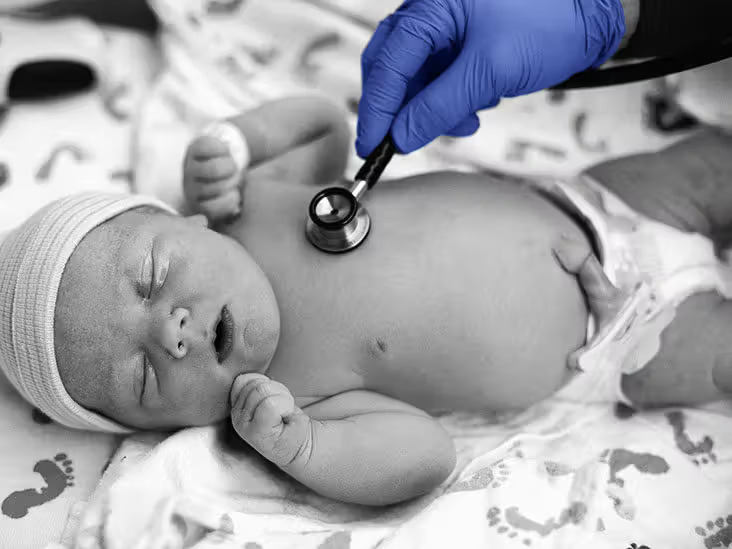
Cyanotic Congenital Heart Disease
What is Cyanotic Congenital Heart Disease?
Cyanotic Congenital Heart Disease (CCHD) refers to a group of birth defects in which oxygen-poor (deoxygenated) blood mixes with oxygen-rich blood, resulting in low oxygen levels in the bloodstream (hypoxemia). This leads to bluish discoloration of the lips, tongue, skin, and nails — known as cyanosis.
Cyanosis occurs because of a right-to-left shunt, meaning blood bypasses the lungs (where oxygen is added) and enters the body without being fully oxygenated.
These heart defects are usually identified early in life — often within hours or days after birth — and require timely evaluation, stabilization, and corrective treatment.
What Is effect of Cyanotic Heart Disease?
Cyanotic heart diseases are structural abnormalities in the heart or great vessels that allow oxygen-poor blood from the right side of the heart to flow directly into the left side and then to the body.
This causes:
Low oxygen levels (hypoxemia)
Bluish appearance of skin and mucosa (Cyanosis)
Breathing difficulty in newborns
Reduced blood supply to vital organs
These defects are often critical, meaning they require urgent medical care.
Why Cyanosis Happens?
Cyanosis results from one or both of the following mechanisms:
Right-to-Left Shunting: Blood bypasses the lungs, mixing oxygen-poor blood with oxygen-rich blood.
Severely Reduced Blood Flow to the Lungs: The heart cannot push enough blood to the lungs to pick up oxygen.
Both mechanisms reduce oxygen delivery to the body, causing visible bluish discoloration.
What are Common Types of Cyanotic Congenital Heart Diseases?
1. Tetralogy of Fallot (TOF) – Also called Blue Baby Disease
The most common cyanotic congenital heart defect, composed of four abnormalities:
Ventricular Septal Defect (VSD)
Pulmonary Stenosis (narrowing of the route to the lungs)
Overriding Aorta
Right Ventricular Hypertrophy
Children with TOF may experience “Tet spells”— sudden episodes of deep cyanosis due to decreased pulmonary blood flow.
2. Transposition of the Great Arteries (TGA)
The aorta and pulmonary artery arise from wrong chambers of heart, leading to:
Oxygen-poor blood circulating repeatedly in the body
Oxygen-rich blood circulating only in the lungs
This is a life-threatening defect requiring urgent intervention after birth.
3. Tricuspid Atresia
The tricuspid valve fails to form, preventing blood from entering the right ventricle.
Newborns depend on small temporary connections like ASD, VSD, or PDA to survive.
Treatment requires staged surgeries.
4. Total Anomalous Pulmonary Venous Return (TAPVR)
The pulmonary veins (which carry oxygenated blood from the lungs) connect to the wrong chamber, causing oxygenated blood to mix with deoxygenated blood.
Obstructed forms of TAPVR are surgical emergencies.
5. Pulmonary Atresia
The pulmonary valve is completely closed, preventing blood from traveling from the heart to the lungs.
Newborns depend on the PDA to get blood to the lungs. This form also requires urgent surgery and staged procedures.
6. Hypoplastic Left Heart Syndrome (HLHS)
The entire left side of the heart — including the ventricle, mitral valve, aortic valve, and ascending aorta — is severely underdeveloped.
This is one of the most critical congenital heart diseases and requires staged surgeries or transplantation.
What are the Symptoms of Cyanotic Heart Disease
Symptoms often appear within minutes to days after birth, but milder forms may present later.
Common signs include:
Bluish lips, tongue, skin, nails (cyanosis)
Rapid or difficult breathing
Poor feeding
Failure to gain weight
Lethargy or fatigue
Tet Spells – Sudden episodes of worsening cyanosis
Irritability in infants due to low oxygen
Squatting Episodes – Child get tired on walking or physical activity and sits in knee-chest position i.e sits with his knees bent and put close to chest
Clubbing of fingers and toes (in long-standing cases)
Heart murmur
If untreated, children may develop:
Delayed growth
Exercise intolerance
Frequent fainting spells
How Cyanotic Heart Diseases are diagnosed?
Doctors use a combination of clinical assessment and investigations to diagnose CCHD.
1. Pulse Oximetry
2. Echocardiography (ECHO)
3. ECG
4. Chest X-Ray
5. CT or Cardiac MRI
6. Cardiac Catheterization
How Cyanotic Congenital Heart diseases are treated?
Treatment depends on the specific defect, severity of cyanosis, and newborn stability.
1. Emergency Stabilization (Immediately After Birth)
Prostaglandin infusion to keep the ductus arteriosus open (critical for TGA, pulmonary atresia, HLHS)
Oxygen support
Ventilation if necessary
IV medications to support heart pumping
Correcting dehydration or acidosis
2. Medications
Used temporarily until surgery:
Drugs to improve heart function
Diuretics
Prostaglandin E1 to maintain ductal flow
Antiarrhythmics (if rhythm disturbances occur)
3. Catheter-Based Interventions
Catheter-based interventions are generally done for stabilization or partial correction, such as:
Balloon Atrial Septostomy — life-saving in TGA
Stenting of PDA to improve lung blood flow
Balloon dilation of narrowed pulmonary valves
A definitive corrective surgery / procedure is often needed after catheter-based interventions.
4. Surgery
Most cyanotic heart diseases require one or more surgeries.
Examples:
Complete Repair
(Such as TOF repair, TAPVR correction)
Staged Surgeries)
For HLHS, Tricuspid Atresia:Stage 1 (Norwood/Shunt)
Stage 2 (Glenn)
Stage 3 (Fontan)
Arterial Switch Operation (ASO)
Lifesaving for TGA
Performed in the first 1–2 weeks of life.
RV-PA Conduits or Shunts
To improve blood flow to the lungs (e.g., BT Shunt)
Heart Transplantation
Rarely required but considered when defects cannot be repaired.
What are long term Complications of untreated Cyanotic Heart Disease?
If untreated or diagnosed late, cyanotic defects can lead to:
Severe hypoxemia
Brain injury or developmental delay
Strokes or blood clots
Polycythemia (very high hemoglobin)
Clubbing
Heart failure
Pulmonary hypertension
Arrhythmias
Sudden cyanotic spells
Early treatment significantly reduces long-term complications.
What is the Long-Term Outlook & Prognosis of Cyanotic Heart Disease?
Due to advances in fetal diagnosis, neonatal care, cardiac surgery, and catheter therapies:
Most babies survive to adulthood
Children can lead active, near-normal lives
Schooling, sports, and daily activity are usually unrestricted (after repair)
Lifelong follow-up is required with a congenital heart specialist
Adults with repaired cyanotic heart diseases may need:
Valve replacements
Arrhythmia management
Periodic imaging
Quality of life is typically very good when early treatment is done.
Note: While many cyanotic heart diseases are treated with excellent results and great long term quality of life, some complex cyanotic heart diseases are not associated with a very long and productive life and need multiple operations in a lifespan. Discuss with your surgeon in deatil about nature of your disease, its natural history and progression and prospects after the surgery, before you take a final infored decision.
Important Guidance for Parents & Caregivers
Seek urgent care for blue spells, fast breathing, or poor feeding.
Ensure regular cardiology follow-up, especially during infancy.
Learn to recognize signs of decreased oxygen.
Vaccinate children fully; flu and pneumonia vaccines are especially important.
Growth, appetite, and weight must be monitored closely.
Ask your cardiologist about exercise guidelines as your child grows.
Adolescents and adults with repaired cyanotic heart di should have endocarditis prevention guidance before certain dental or surgical procedures.

MBBS, MS, MCh, FRCS-CTh,
FRCS-CTh(Ed), MEBCTS, FEBCTS, FACS(USA), DNB, MNAMS, MBA
Senior Consultant – Cardiothoracic & Vascular Surgery
National Heart Institute, New Delhi
Frequently Asked Questions
Can cyanotic heart disease be detected before birth?
Yes, most severe forms can be detected through fetal echocardiography at 18–22 weeks.
Will my baby need immediate surgery?
Not always, but many critical defects require intervention shortly after birth.
Can my child live a normal life after treatment?
In most cases, yes. Modern surgical techniques offer excellent long-term outcomes.
Some complex cyanotic heart diseases are not associated with a very long and productive life and need multiple operations in a lifespan.Discuss with your surgeon in deatil about nature of your disease, its natural history and progression and prospects after the surgery, before you take a final infored decision.
Will medication be lifelong?
Usually not, except in special cases. Most medications are temporary.
Are these defects genetic?
Most occur spontaneously, but some may be associated with chromosomal or genetic syndromes (e.g., DiGeorge syndrome).
Will my child need lifelong follow-up?
Yes. Even after repair, periodic evaluation ensures early detection of late complications.
Can Cyanotic Heart Diseases be Prevented?
While congenital defects cannot always be prevented, their risks can be decreased, important steps include:
Healthy prenatal care
Avoid smoking, alcohol, and harmful medications during pregnancy
Control maternal diabetes
Folic acid supplementation before and during pregnancy
Rubella vaccination before pregnancy
Genetic counselling for families with multiple congenital heart disease cases
When to Seek Urgent Medical Attention?
Consult a doctor immediately if a newborn or child has:
Blue or pale, cold skin
Fast or labored breathing
Poor feeding or refusal to feed
Excessive sleepiness or unresponsiveness
Seizures
Sudden worsening of cyanosis
Recurrent fainting
For any queries on this topic
Mail to: drkeshriheartcare@gmail.com or Click Here For WhatsApp (Text msg Only):