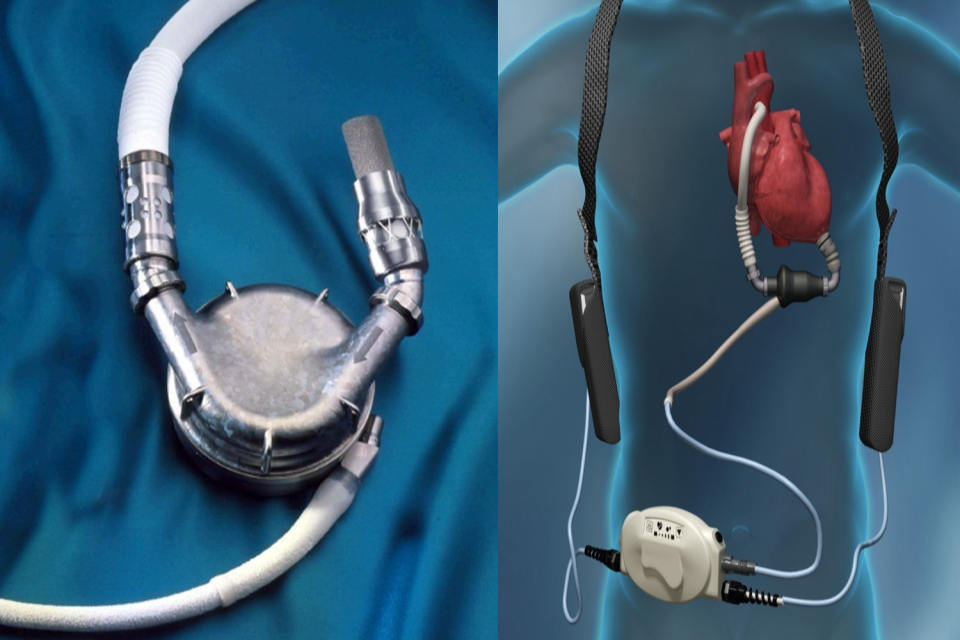
Ventricular Assist Devices (VADs)
Ventricular Assist Devices (VADs) are advanced mechanical pumps that help the heart’s ventricles — the right or left lower chambers — pump blood effectively when the heart becomes too weak to function on its own.
VADs have revolutionized the treatment of advanced heart failure, offering life-saving support to patients who would otherwise have extremely limited options.
A VAD can support:
the left ventricle (LVAD),
the right ventricle (RVAD), or
both ventricles (BiVAD)
depending on the severity and type of heart failure.
These devices can be used temporarily or permanently, and their role depends on the patient’s condition and overall treatment plan.
Purpose of a VAD
Ventricular Assist Devices serve several essential roles in advanced heart failure management:
- Bridge to Transplant (BTT)
Keeps patients stable until a suitable donor heart becomes available.
- Destination Therapy (DT)
Long-term therapy for patients who cannot undergo a heart transplant due to age or medical limitations.
- Bridge to Recovery (BTR)
Used temporarily to give the weakened heart rest so it can regain strength and normal function.
- Bridge to Decision (BTD)
Supports patients while doctors decide whether recovery, transplant, or long-term VAD therapy is the best plan.
- Post-Cardiotomy Support
Used when the heart fails to restart adequately after major heart surgery.
- Support During Severe Cardiogenic Shock
Helps maintain blood flow when the heart suddenly becomes too weak to pump.
How Does a Ventricular Assist Device Work?
A VAD performs the heart’s pumping role by ensuring that oxygen-rich blood reaches all vital organs.
Key Components of a VAD:
Pump
Implanted inside the chest and attached to the ventricle. It moves blood forward with continuous or pulsatile flow.Driveline
A thin cable that passes through the skin and connects the internal pump to the external controller.Controller
A small computer that regulates pump speed, flow, alarms, and system functioning.Power Source
Rechargeable batteries or an AC power unit that keep the pump running continuously — VADs cannot be turned off while implanted.
How an LVAD Works (Most Common Type)
It draws blood from the left ventricle.
Pumps it into the aorta.
Ensures continuous blood flow to the entire body.
Modern LVADs produce continuous flow, so many patients do not have a palpable pulse — which is completely normal.
Types of Ventricular Assist Devices
1. Left Ventricular Assist Device (LVAD)
- Supports the left ventricle, which pumps blood to the entire body.
- Most commonly used in end-stage heart failure.
- Can be temporary or permanent (Destination Therapy).
- Significantly improves survival and quality of life.
2. Right Ventricular Assist Device (RVAD)
- Supports the right ventricle, which pumps blood to the lungs.
- Used in right-sided heart failure, often after LVAD implantation or major heart surgery.
- Mostly temporary until the right ventricle recovers.
3. Biventricular Assist Device (BiVAD)
- Supports both ventricles simultaneously.
- Used in severe biventricular heart failure where both sides of the heart are extremely weak.
4. Temporary / Short-Term VADs
Examples include Impella, TandemHeart, and ECMO-based circulatory support.
Used for short durations in cardiogenic shock until the heart recovers or long-term decisions are made.
Candidates for VAD Implantation
A VAD may be recommended for patients who:
Have advanced heart failure (Stage D) unresponsive to medicines
Experience persistent symptoms such as breathlessness, swelling, and fatigue
Are awaiting heart transplant
Have cardiomyopathy (dilated, ischemic, or genetic)
Are not immediately eligible for transplant due to medical instability
Have repeated hospitalizations for heart failure
Show low cardiac output and end-organ dysfunction
Before VAD surgery, patients undergo:
Echocardiogram
CT scans
Heart catheterization
Blood tests
Kidney and liver function assessment
Psychosocial evaluation
Nutritional assessment
This ensures safe selection and optimal outcomes.
Procedure Overview
VAD implantation is a major but well-established surgery performed by a specialized cardiac team.
Surgery Steps:
General anesthesia is given.
Midline chest incision (sternotomy) is made to access the heart.
The pump is attached to the ventricle, and an outflow graft connects it to the aorta or pulmonary artery.
The driveline is tunneled through the abdominal wall.
The external controller and battery system are connected.
Once activated, the VAD begins supporting the heart immediately.
Postoperative Care
2–4 days in the ICU
Close monitoring of heart function, bleeding, blood pressure, and pump parameters
Early physiotherapy and rehabilitation
Training on driveline care and device management
Advantages of VADs
VAD implantation is a major but well-established surgery performed by a specialized cardiac team.
Surgery Steps:
General anesthesia is given.
Midline chest incision (sternotomy) is made to access the heart.
The pump is attached to the ventricle, and an outflow graft connects it to the aorta or pulmonary artery.
The driveline is tunneled through the abdominal wall.
The external controller and battery system are connected.
Once activated, the VAD begins supporting the heart immediately.
Postoperative Care
2–4 days in the ICU
Close monitoring of heart function, bleeding, blood pressure, and pump parameters
Early physiotherapy and rehabilitation
Training on driveline care and device management
Recovery and Lifestyle After VAD
Patients and caregivers are trained in:
Controller operation
Battery changes
Driveline exit site cleaning
Recognizing alarms
Emergency procedures
Lifestyle Recommendations:
Avoid bathing/ swimming (to prevent driveline infection)
Avoid contact sports
Maintain a low-sodium diet
Continue anticoagulation (blood thinners)
Monitor weight and blood pressure
Stay connected to the VAD care team
Most patients return to good functional capacity within weeks.
Long-Term Care After VAD Implantation
Regular Monitoring Includes:
INR/blood thinner levels
Echocardiograms
Pump speed and flow adjustments
Infection checks
CT scans if needed
Emergency Situations to Watch For
Sudden alarms on controller
Reduced pump flow
Driveline damage
Dizziness or fainting
Bleeding in stools or urine
Quick contact with the VAD team is essential in such cases.
Risks and Complications
Although VADs are extremely effective, some risks remain:
Driveline infection
Blood clots leading to stroke
Bleeding, especially from blood thinners
Right heart failure after LVAD implantation
Device malfunction or battery issues
Pump thrombosis (clot inside the device)
With regular follow-up and expert management, these risks can be minimized.

MBBS, MS, MCh, FRCS-CTh,
FRCS-CTh(Ed), MEBCTS, FEBCTS, FACS(USA), DNB, MNAMS, MBA
Senior Consultant – Cardiothoracic & Vascular Surgery
National Heart Institute, New Delhi
Frequently Asked Questions
Will I still feel a pulse after LVAD implantation?
Most modern LVADs create continuous flow, so many patients will not have a detectable pulse — this is normal and safe.
Can I travel with a VAD?
Yes. Patients can travel by car, flight, or train after recovery. Always carry backup batteries, controller, and emergency contact numbers.
Can VAD patients participate in sexual activity?
Yes. Once recovery is complete and doctors approve, patients can resume normal intimate relationships.
How long can someone live with an LVAD?
Modern LVADs can function many years, with some patients living 5–10 years or more, depending on overall health and follow-up.
Is VAD implantation reversible?
Yes, in Bridge to Recovery cases, the device can be removed if the heart regains strong function.
Can patients sleep normally with a VAD?
Yes. Most patients adjust easily. They sleep with the controller placed safely nearby.
What happens if the battery fails?
The controller gives early alarms. Patients always carry spare batteries and can connect to an AC power source.
Do VADs make noise?
Yes, most pumps produce a soft humming sound. It is completely normal.
Can I drive with an LVAD?
Yes, once cleared by your VAD team and after full recovery, most patients can resume driving.
How is blood pressure measured after VAD implantation?
Most modern LVADs provide continuous, non-pulsatile blood flow, which means the pulse may not be detectable in the usual way.
Therefore, blood pressure is measured using:
Doppler Ultrasound Method
A handheld Doppler probe detects blood flow while a blood pressure cuff is inflated.
The pressure at which sound returns is called the Mean Arterial Pressure (MAP).
MAP (Mean Arterial Pressure) is the key measurement
Ideal MAP for LVAD patients: 70–90 mmHg
(Instead of “systolic/diastolic,” only MAP is used.)
Automatic BP machines often fail to read BP, so Doppler is the standard and most reliable method.
For any queries on this topic
Mail to: drkeshriheartcare@gmail.com or Click Here For WhatsApp (Text msg Only):